
If you have ever stared at a birth certificate written in Shamsi and needed the Gregorian equivalent for a visa application, you already know the frustration. You search online, land on a converter that handles only two calendar systems, and still end up doing rough mental arithmetic. There is a better way — and this guide walks you through everything you need to know about converting dates between the world's major calendar systems, quickly and accurately.
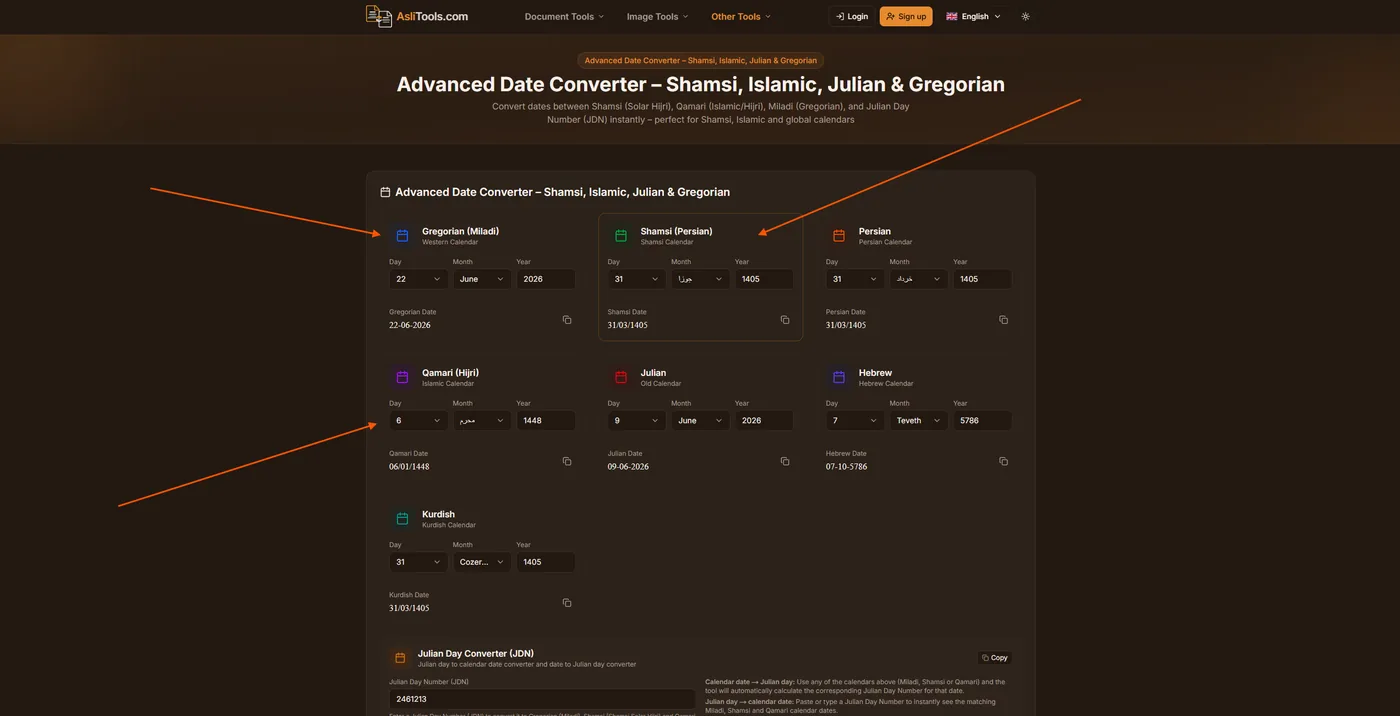
We built the free online date converter at Asli Tools specifically to solve this problem. It supports seven calendars simultaneously — Gregorian (Miladi), Shamsi (Solar Hijri), Persian (Jalali), Qamari (Islamic Hijri), Julian, Hebrew, and Kurdish — and converts all of them at once the moment you enter any date.
Why Do We Have So Many Calendar Systems?
Before diving into conversions, it helps to understand why multiple calendar systems exist in the first place.
Human civilisations built their calendars around what they could observe — the sun, the moon, or both. Cultures that depended on agriculture tracked the solar year to know when to plant. Cultures with strong religious lunar traditions followed the moon's phases for festivals and prayers. Some civilisations combined both into lunisolar systems.
The result is that today, billions of people across the Middle East, Central Asia, South Asia, and the Jewish world officially use calendars that run parallel to — but do not align with — the Gregorian calendar. For Afghans, Iranians, and the broader Persian-speaking diaspora in the UK, Germany, Canada, Australia, and the US, switching between Shamsi dates and Gregorian dates is a practical, daily need.
The Seven Calendar Systems Explained
1. Gregorian Calendar (Miladi / میلادی)
The Gregorian calendar is the international standard. Pope Gregory XIII introduced it in 1582 as a reform of the earlier Julian calendar. It is a solar calendar with 365 days per year and 366 in a leap year. Most countries use it for legal documents, business contracts, and civil records.
In Persian and Arabic, it is called Miladi (میلادی), meaning "of the birth" — a reference to its epoch being the birth year of Jesus Christ.
2. Shamsi Calendar (Solar Hijri / شمسی)
The Shamsi calendar is the official calendar of Afghanistan and Iran. It is a solar calendar, meaning it tracks the Earth's journey around the sun. The Shamsi year begins on Nowruz — the first day of spring — which usually falls on March 20 or 21 in the Gregorian calendar.
The Shamsi year 1404 currently corresponds to March 2025 – March 2026 in Gregorian. The first six months of the Shamsi year have 31 days each, the next five months have 30 days, and the final month (Hoot/Esfand) has 29 days in regular years and 30 in leap years.
Practical note: Afghan official documents — tazkiras, birth certificates, school records — use Shamsi dates. When Afghans apply for visas, asylum, or residency abroad, they routinely need to convert these dates to Gregorian. Our Shamsi to Gregorian date converter handles this instantly without any manual calculation.
3. Persian Calendar (Jalali / تقویم جلالی)
The Persian calendar uses the same astronomical calculations as the Shamsi calendar but displays month names in Persian script: Farvardin, Ordibehesht, Khordad, Tir, Mordad, Shahrivar, Mehr, Aban, Azar, Dey, Bahman, and Esfand. The Shamsi and Persian calendars are effectively identical in terms of date values — the difference is cosmetic, relating to month naming conventions.
4. Qamari Calendar (Islamic Hijri / قمری)
The Qamari — meaning "lunar" in Arabic — calendar is the calendar of Islamic religious observance. It has 12 lunar months, but because lunar months are approximately 29.5 days long, the Islamic year totals only about 354 or 355 days. This makes it roughly 10–11 days shorter than the Gregorian solar year.
This is why Ramadan, Eid al-Fitr, and Eid al-Adha shift earlier each Gregorian year. Over a 33-year cycle, these Islamic occasions pass through every season of the Gregorian calendar.
The Islamic calendar epoch is the Hijra — the migration of the Prophet Muhammad (PBUH) from Mecca to Medina in 622 CE. The current Hijri year is 1446–1447 AH.
5. Julian Calendar
Julius Caesar introduced the Julian calendar in 45 BCE as a reform of the Roman calendar. It remained the dominant calendar in Europe for over 1,600 years until Gregorian reform replaced it. Some Eastern Orthodox churches still use the Julian calendar for religious observances.
For historians and archivists working with documents from medieval Europe or early Islamic history, converting Julian dates to Gregorian is a regular task. The Julian calendar currently runs 13 days behind the Gregorian calendar.
6. Hebrew Calendar (Jewish Calendar)
The Hebrew calendar is a lunisolar system — it uses lunar months but adds a 13th "leap month" in certain years to stay roughly aligned with the solar year. This ensures that Jewish holidays always fall in the correct season.
The Hebrew calendar year is traditionally counted from the biblical date of creation, placing the current year around 5785–5786.
7. Kurdish Calendar
The Kurdish calendar is a solar calendar closely tied to the Shamsi/Jalali system, sharing the same Nowruz starting point. It uses Kurdish month names and is used among Kurdish communities in Turkey, Iraq, Syria, and Iran for cultural events and regional identity.
How to Convert Dates Online — Step by Step
Using the Asli Tools date converter takes under ten seconds. Here is exactly how it works:
Step 1: Open the tool
Go to the date converter. The tool loads directly in your browser — no account, no download, no waiting.
Step 2: Enter your date in any calendar
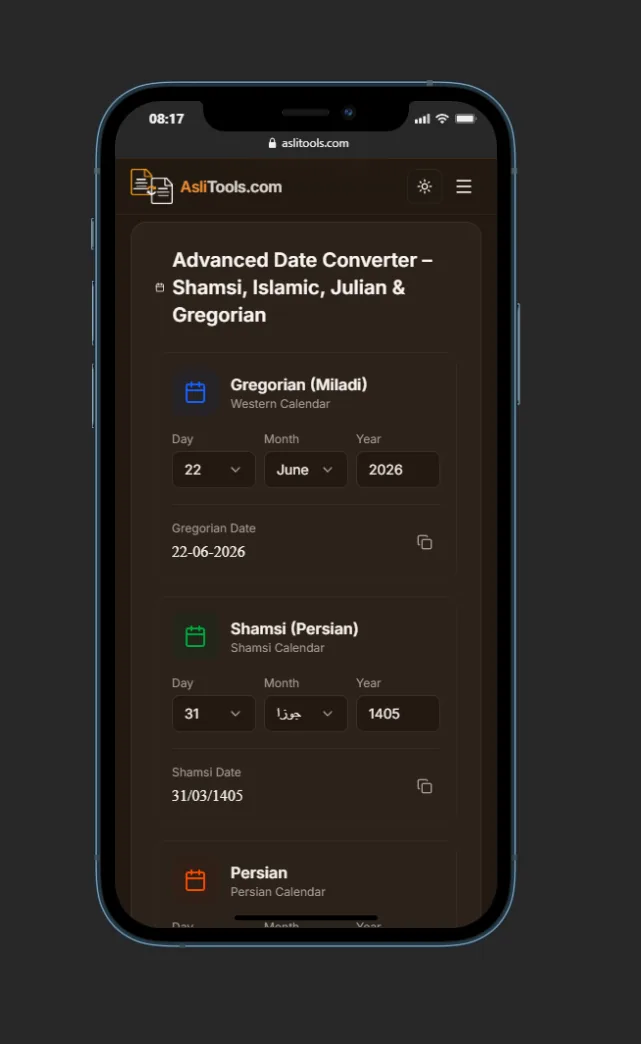
Select the day, month, and year using the dropdowns in whichever calendar system your date is written in. If your Afghan birth certificate says 15 Mizan 1372 (Shamsi), enter that in the Shamsi section.
Step 3: All other calendars update instantly
The moment you enter a date, the tool simultaneously displays the equivalent date in all six remaining calendar systems. You see the Gregorian, Persian, Qamari, Julian, Hebrew, and Kurdish equivalents at a glance — no clicking a "convert" button.
Step 4: Copy the result you need
Each calendar section has a copy button. Click it to copy the converted date directly to your clipboard, ready to paste into a form, document, or email.
Step 5: Use the Julian Day Number section (optional)
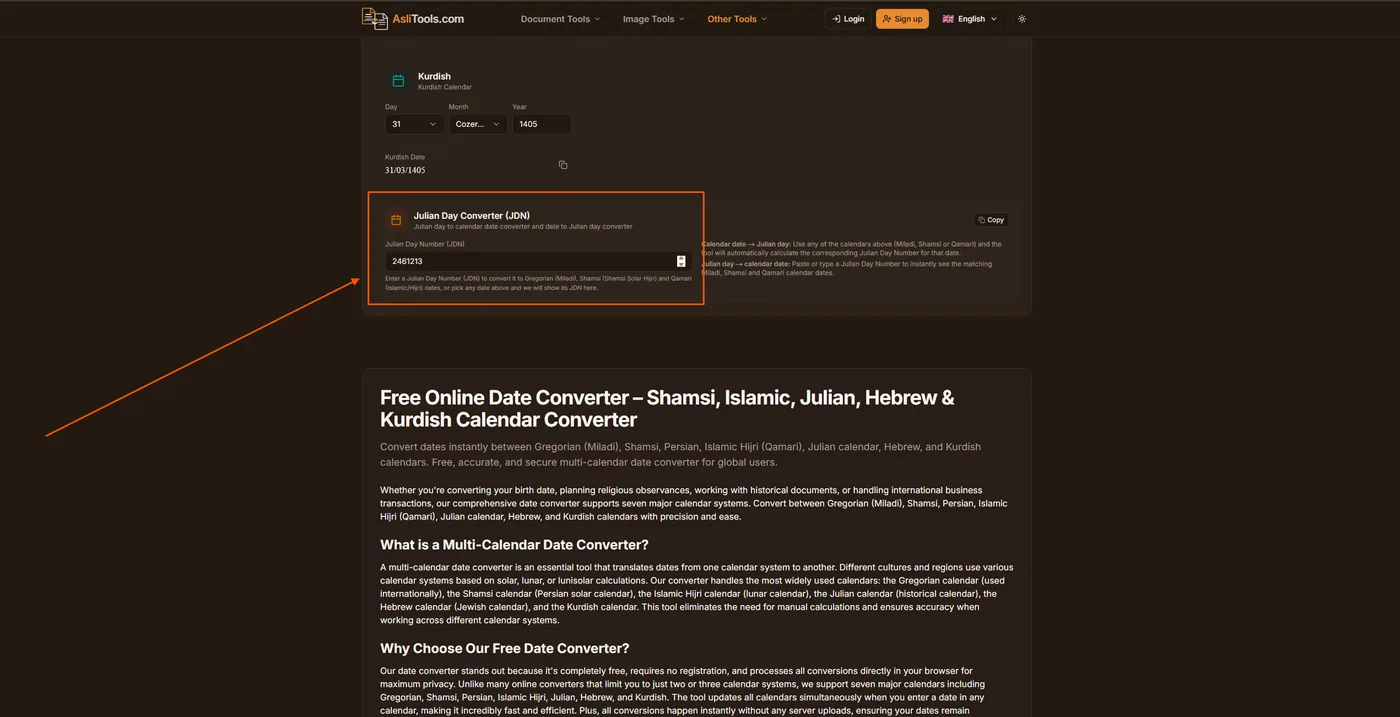
The tool also includes a Julian Day Number (JDN) converter. Enter any JDN to get the corresponding date in all seven systems, or enter a calendar date to see its JDN. This is particularly useful for historians, astronomers, and researchers who work with archival date records.
Real-World Use Cases: When You Actually Need a Date Converter
Converting a Shamsi Birth Date for a Visa or Asylum Application
Afghans applying for visas, residency, or asylum in Europe, North America, or Australia frequently need to convert Shamsi dates to Gregorian. Government forms require the date of birth in the Gregorian system, but tazkiras and Afghan school certificates record dates in Shamsi.
A quick conversion: 1 Hamal 1372 in Shamsi equals 21 March 1993 in Gregorian.
Planning Ramadan and Islamic Holidays
Muslims worldwide use the Hijri calendar to track Ramadan, the two Eids, and Muharram observances. But coordinating these dates with work schedules, school calendars, and travel plans requires knowing the Gregorian equivalent. Our Qamari to Gregorian converter gives you this answer in one step.
Genealogical Research and Historical Documents
Old Ottoman, Persian, and European records use a mix of Julian, Hijri, and Solar Hijri dates. A family historian tracing ancestors through 19th-century records might find dates in three different systems on three different documents. Converting them to a common reference point — either Gregorian or Julian Day Number — makes it possible to construct an accurate timeline.
International Business and Contracts
Companies operating across Iran, Afghanistan, Saudi Arabia, and Israel deal with dates from multiple calendar systems on invoices, contracts, and correspondence. A contract signed on 10 Dey 1402 (Shamsi) in Iran and acknowledged on 15 Jumada al-Awwal 1445 (Hijri) in Saudi Arabia needs to map to a single Gregorian reference date for international legal purposes.
Working with Ancestral Land Records in Afghanistan
Afghan land deeds (sanadat) often carry Shamsi dates or occasionally older Persian calendar references. Converting these dates helps lawyers and families establish legal timelines when resolving property disputes or applying for restitution.
Common Mistakes When Converting Calendar Dates
Mistake 1: Assuming Shamsi and Hijri are the same
Both originate from the Hijra event in 622 CE, but the Shamsi calendar is solar and the Hijri (Qamari) calendar is lunar. They are currently about 43 years apart. The Shamsi year is 1404 while the Hijri year is 1447 — a difference that grows slowly over time.
Mistake 2: Adding 621 or 622 without accounting for the month
A common shortcut is to add 621 or 622 to a Shamsi year to get the approximate Gregorian year. This works roughly, but it is off by up to a year depending on the month. Shamsi Nawruz falls on March 20–21 in Gregorian, so a Shamsi date in months 1–6 corresponds to a Gregorian date roughly 621 years later, while months 10–12 may correspond to a Gregorian year 622 years later. Always use an accurate tool for official documents.
Mistake 3: Ignoring the 13-day Julian–Gregorian difference
If you are working with historical European documents before 1582 — or Russian documents before 1918 — they may use the Julian calendar. Treating a Julian date as a Gregorian date introduces a 13-day error that matters for historical timelines and genealogical records.
Mistake 4: Using calculators that handle only two calendars
Many online tools convert only between Shamsi and Gregorian, or only between Hijri and Gregorian. If you need the Hebrew equivalent of an Islamic date, you would need two separate conversions. The Asli Tools date converter eliminates this by showing all seven calendars at once.
What is a Julian Day Number (JDN)?
The Julian Day Number is not related to the Julian calendar. It is an entirely different concept used in astronomy and historical chronology.
A JDN is a continuous count of days starting from noon on 1 January 4713 BCE (Julian calendar). It gives every date in history a single, unambiguous integer. Today's JDN (as of mid-2026) is approximately 2,461,000.
Historians use JDNs to calculate the exact number of days between two events across different calendar systems. Astronomers use them for orbital calculations. Software developers use them as a reliable internal date representation when building calendar applications.
Our tool converts any JDN to its equivalent in all seven calendar systems, and converts any calendar date to its JDN.
How the Asli Tools Date Converter Compares to Other Tools
Most date converter tools online focus on a single calendar pair. IslamicFinder's Hijri converter handles Hijri to Gregorian well but stops there. IranVBA's tool is solid for Shamsi conversions but requires more steps and offers no Hebrew or Kurdish support.
The Asli Tools date converter is currently one of the only free, browser-based tools that handles all seven calendars — Gregorian, Shamsi, Persian, Qamari, Julian, Hebrew, and Kurdish — simultaneously in a single interface, with no sign-up and no server uploads.
Everything runs directly in your browser. Your dates never leave your device. This matters when you are entering personal information like dates of birth for visa applications.
Other Tools You Might Find Useful on Asli Tools
While you are here, Asli Tools offers a growing suite of free utilities that work the same way — entirely in your browser, no account needed, no file uploads to servers:
- Age Calculator — Calculate your exact age in years, months, and days from any birth date
- Zakat Calculator — Calculate Zakat on wealth, gold, silver, and business assets
- Salary Tax Calculator — Estimate net salary after tax deductions
- PDF Merger — Combine multiple PDF files into one document
- PDF Compressor — Reduce PDF file size without losing quality
- JPG to PNG Converter — Convert image formats instantly in your browser
All 170+ tools on Asli Tools are free to use and built with the same privacy-first approach.
Final Thoughts
Date conversion between Shamsi, Hijri, Gregorian, and other calendar systems is not a niche problem — it affects millions of people every day. Afghan diaspora communities filling in immigration forms, Muslims planning religious observances, historians working with archival records, businesses operating across the Middle East and Central Asia — all of them need accurate, fast date conversion.
The free date converter at Asli Tools handles all of this in one place, supports seven calendar systems simultaneously, works entirely in your browser for complete privacy, and costs nothing. No sign-up, no watermarks, no limits.
Next time you need to convert a Shamsi date to Gregorian — or a Hijri date to Hebrew, or any other combination — start there.
Convert dates between seven calendars free →
Written by the Asli Tools team. We build free, private, browser-based tools for users worldwide. Questions? Reach us at contact@aslitools.com.